Categories
Gazetteer

Sears Gazetteer – Montana

The Sears Gazetteer contains a list of locations in the USA with the name Sears, compiled by Ray Sears over the years. Also see MaineMississippiAlaska, New Mexico, Virginia and others on this site.

Montana has 11 placemarks, including the former town of Sears, Montana.

Much of the information below comes from the Montana Memory Project, and “Courage Enough Mon-Dak Family Histories Bi-Centennial Edition”.

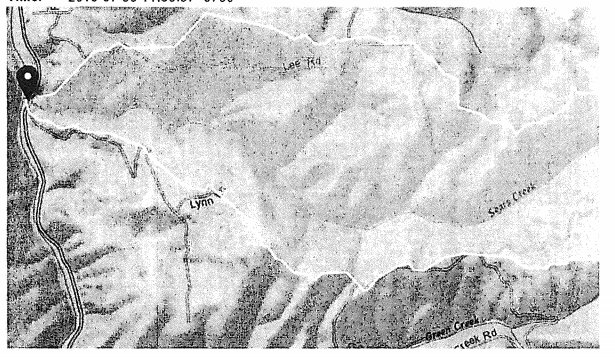
Sears Creek

Sears Creek is located in Richland County, at 47.5502937°N, -104.2654957°W.

Richland County was previously known as Dawson County.

Early Ranches of Dawson County.

https://mtmemory.org/digital/collection/p15018coll43/id/24243

A quote from a quote, “Quoting from the Sidney Herald Centennial Souvenir Edition, 1964, and from the records of Walter Kemmis: “When the Thompson Kemmis family arrived in Glendive, Montana Mr. Meadors met them. While Walter, 14, was following him around town to do some business, they visited Mr. and Mrs. J. D. Sears who had a shoemaker shop. In later years Walter was to know J. D. well, as he ventured into the sheep business in the valley, and Sears Creek was named after him.”

https://mtmemory.org/digital/collection/p15018coll43/id/23906

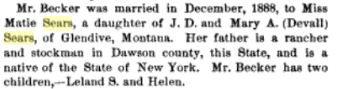
J.D. Sears

“from an obituary John D. Sears, old-time resident of Glendive, Montana died at Tom’s Creek, Virginia, on December 2. He was 96 years of age. He left Glendive 25 years ago and since then has lived in Virginia. His wife preceded him in death about two years ago. He formerly owned a shoe shop on Merrill Avenue and was one of the early settlers in Glendive. He and his wife were the first two members of the local Methodist Church. He leaves two daughters, Mrs. E. S. Becker of Virginia and Mrs. Gunn of Washington and several grandchildren, among them Harry and John Matthews, formerly of Glendive and Leland Becker who is now in Siberia. – Dawson County Review. Mr. Sears once resided on Sears Creek at Midway, the creek being named after him. He had a sheep ranch at the present site of the Pete Maney farm. Surviving pioneers in Sidney and territory will hark back in memory many years at this news of his death.”
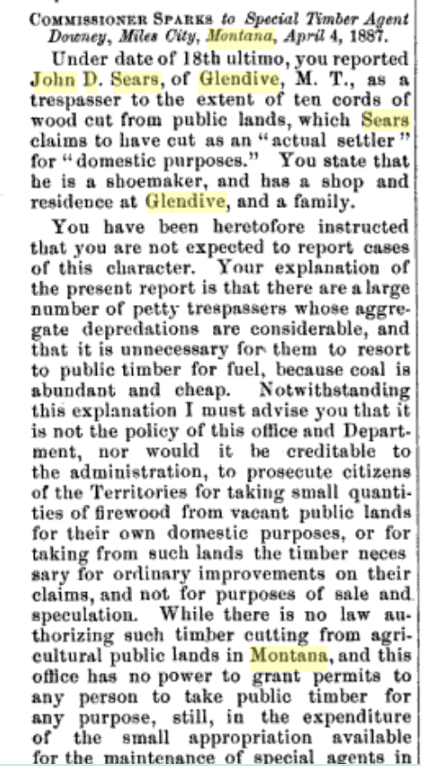
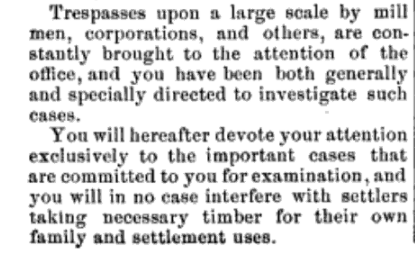
Special Timber Agent Downey of Miles City, Montana was thoroughly chastized when he tried to get Mr. Sears in trouble for cutting down 10 cords of public forest.
https://tinyurl.com/yad66uwn

Another J.D. Sears, geologist Julian Ducker Sears (1891-1970) and a memorial to him.

https://www.geosociety.org/documents/gsa/memorials/v02/Sears-JD.pdf

This J.D. Sears surveyed and mapped the Lake Basin Field of Montana.
https://pubs.usgs.gov/bul/0691d/report.pdf

Categories
Gazetteer

Sears Gazetteer – Idaho

The Sears Gazetteer contains a list of locations in the USA with the name Sears, compiled by Ray Sears over the years. Also see MaineMississippiAlaska, New Mexico, Virginia and others on this site.

Idaho has a single placemark, Sears Creek.

Sears Creek

Turning off Highway 13 onto Sears Creek Road takes us to Sears Creek, a tributary of South Fork Clearwater River. Sears Creek is not on the List of National Wild and Scenic Rivers for Idaho.  It is often dry during low-flow.  According to this soil and water conservation application, it is assessed as a prime spawning stream.

Sears Creek Road crosses Wall Creek, and ends at Old Elk City Wagon Road.  This road is listed on the National Register of Historic Places.

From 1895 to 1932, the Elk City Wagon Road provided a vital route for wheeled traffic into the rugged Clearwater Mountains in north central Idaho. The Wagon Road linked the gold fields of the upper Clearwater country with established transportation routes to the west. Built roughly along the route of the Southern Nez Perce Trail, the wagon road connected Harpster in the west to Elk City to the east.

Harpster, established in 1897, is the closest town to Sears Creek. Harpster is about 8 1/2 hours from the Canadian border, 3 1/2 hours from Missoula, Montana. The area in and around Harpster includes 2,244 nearby mines

The communities of Stites and Harpster look back upon a history which includes the Nimiipuu (Nez Perce), Lewis and Clark, gold seekers, loggers, cowboys, and homesteaders.

At the turn of the 20th century, Stites and Harpster, the terminus for the railroad and Elk City Wagon Road, provided a transportation hub for the upper Clearwater gold country and Camas Prairie farmers and ranchers.

Today, the communities provide a focal point for historic adventure and outdoor recreation.


Hardy Sears, born 1841 in Randolph County, Missouri, is mentioned on the Albion Valley Historical Society web site. He settled on a creek, though it wasn’t the Sears Creek…

He served in the Union Army.  Mined in Nevada and Montana, raised cattle on the Promentery in Utah.  He helped complete the Union Pacific Railroad in Utah and was present when the golden spike was driven in celebration of the event.  Minidoka hotel business.

In 1870 Hardy Sears and Dan Stark settled on adjoining pieces of land that could be watered by a creek.  Here they built their cabins.

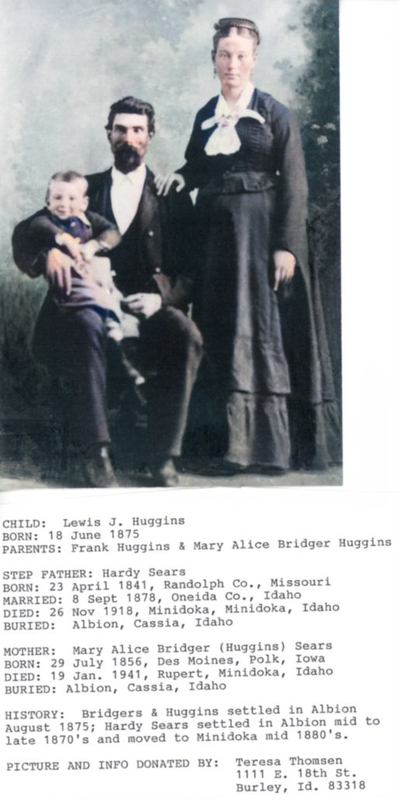
Hardy Sears, Wife and Stepchild Lewis J. Huggins
DeOldify

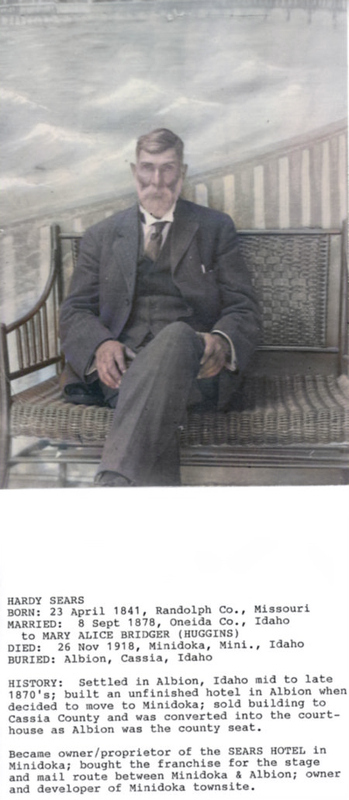
Hardy became the proprietor of the Sears Hotel, which he purchased in 1894 after serving with the confederacy in the Civil War. The hotel was sold and torn down in the late 1950s.

Hardy Sears, later years
DeOldify

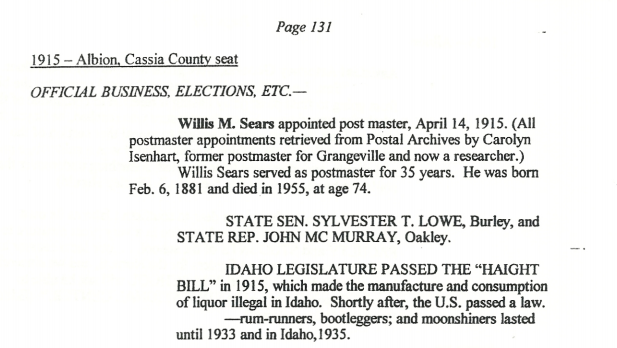
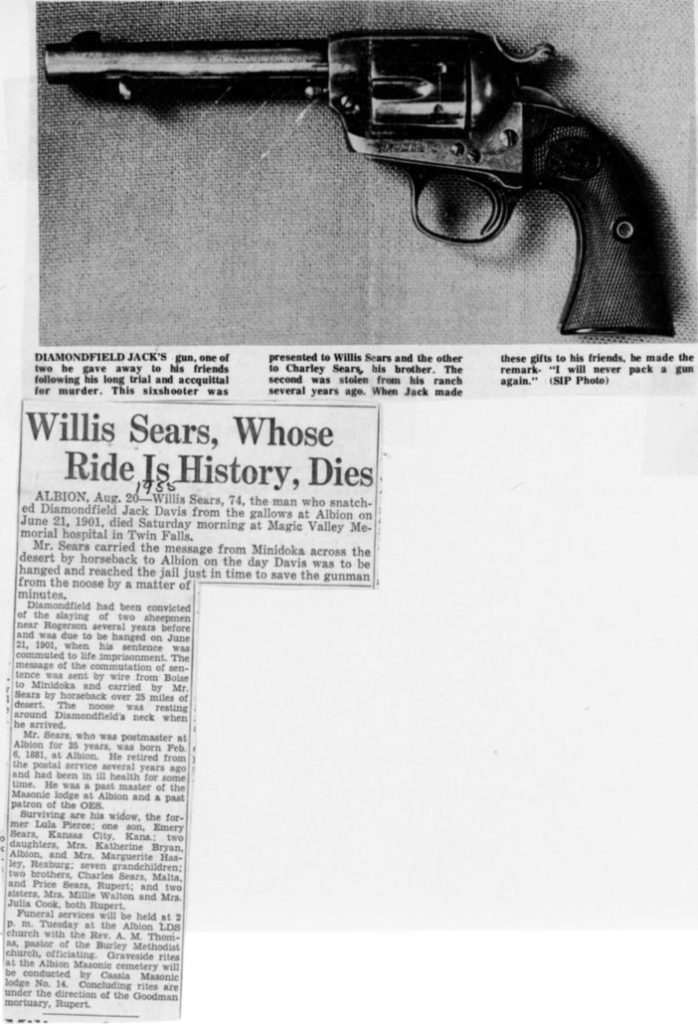
Willis Sears was one of Hardy’s sons. Willis served as a postmaster in Idaho for 35 years.

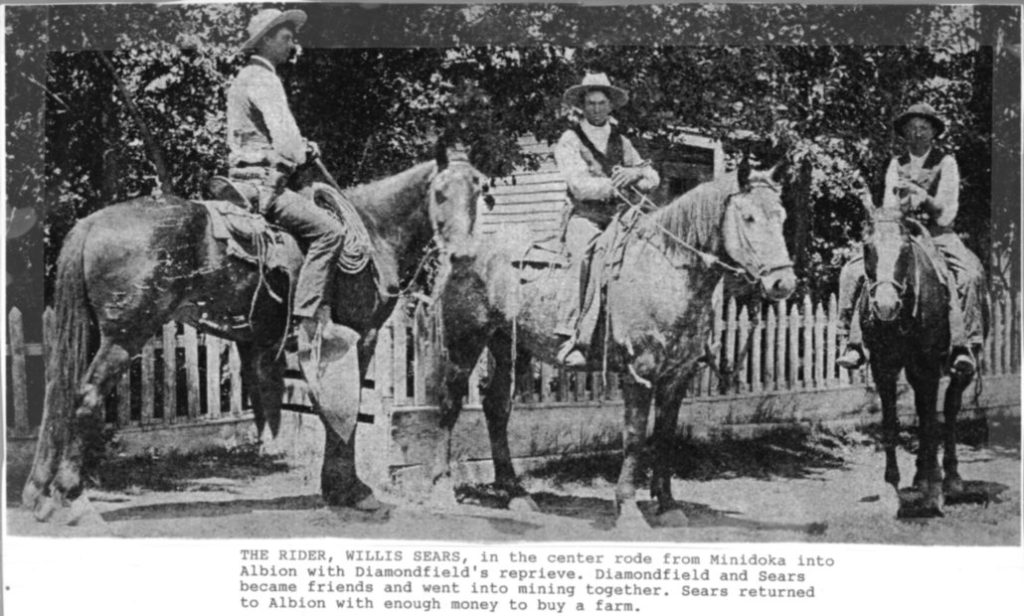
Willis is famous for having saved “Diamondfield Jack’s” life.

Willis Sears, Albion Postmaster, rode from Minidoka to Albion with Charley Christ in July, 1901, with papers from Boise that commuted the sentence of Diamondfield Jack Davis to life imprisonment.  They made the ride on the day Davis was to have been hanged.

A fascinating story about Willis and Diamondfield Jack is on the Minicassa.com web site, The Willis Sears-Diamond Field Jack Connection.

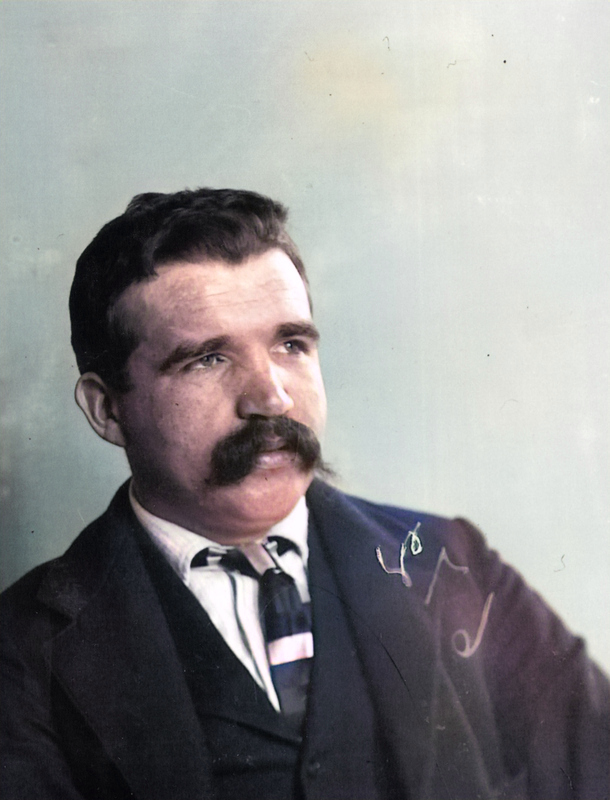
Jackson Lee “Diamondfield Jack” Davis was accused of the murders of sheepherders, while patrolling for sheepherders working on cattle land in Idaho.

Diamondfield Jack
Deoldify

Diamondfield Jack befriended Sears, and lived quite awhile longer than 1901. His death sentence eventually came to him via a taxi cab in Vegas.

By 1900, Diamondfield Jack had exhausted all of his appeals. He was again scheduled for execution, this time on July 3, 1901. The public was opposed to this and believed Diamondfield Jack to be innocent. Aware of public support from some very influential citizens, the Board of Pardons extended the execution date to July 17. Word arrived in Cassia County three hours before the sheriff would have carried out the execution.

On July 16, 1901, the Board of Pardons commuted Diamondfield Jack’s death sentence to that of life imprisonment. He was again moved to the Idaho State Penitentiary to serve his time.

On December 17, 1902, the Board of Pardons granted Diamondfield Jack a pardon. He moved to Nevada and made a fortune in the Tonopah mining district. He later lost his fortune and was killed in 1949 when he was struck by a taxi cab in Las Vegas, Nevada.


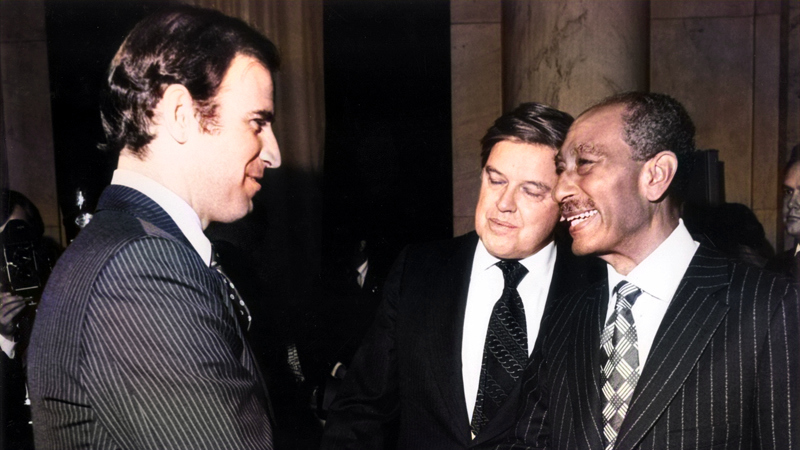
One famous senator, and someone who shaped Idaho is the late Frank Church. The Frank Church – River of No Return Wilderness Area, a 2.4 million acre wilderness park is the largest area outside of Alaska.

Joe Biden and Frank Church
DeOldify

Frank Church served as US Senator of Idaho from 1957 to 1981.


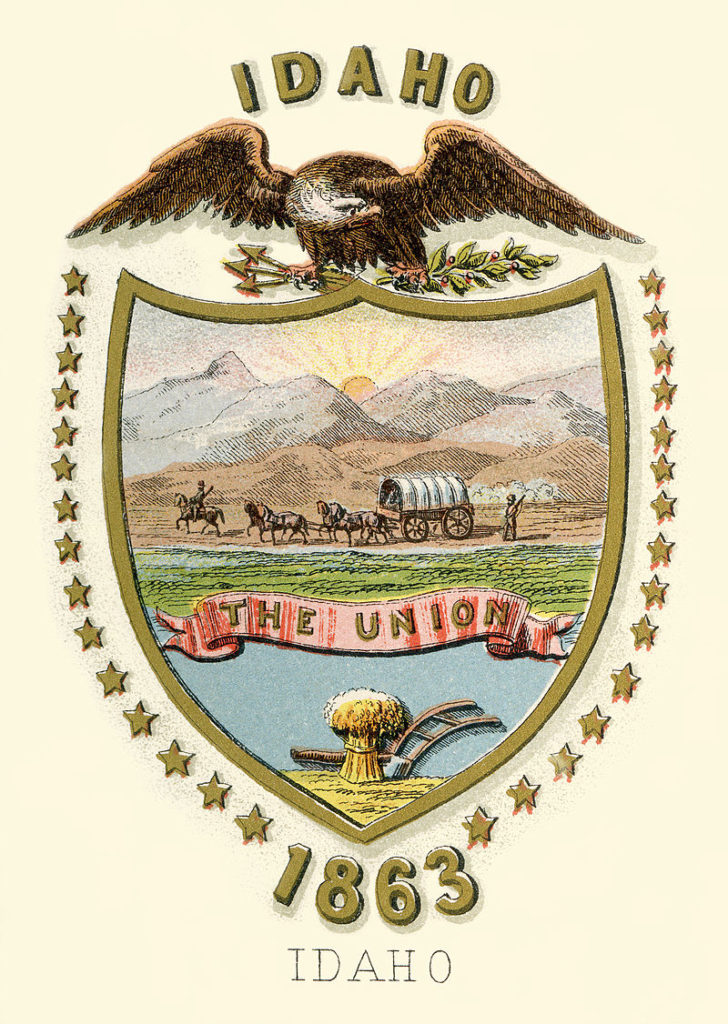
Idaho Territory Coat of Arms

Also see:

Random Acts of Genealogical Kindness
https://raogk.org/counties/idaho/

Idaho State Museum (TripAdvisor)

https://www.tripadvisor.ca/Attraction_Review-g35394-d214899-Reviews-Idaho_State_Museum-Boise_Idaho.html

IDAHO Official Government Web Site
https://history.idaho.gov/maps/

Categories
Gazetteer

Sears Gazetteer – Alaska

The Sears Gazetteer contains a list of locations in the USA with the name Sears, compiled by Ray Sears over the years. Also see Sears Gazetteer – Maine and Sears Gazetteer – Mississippi.

Sears Creek is a stream in Dry Creek, Southeast Fairbanks Census Area (CA) Alaska. Sears Creek runs under a bridge of the Alaska Highway 2.

Sears Creek Pumping Station
Christine McClain papers, Archives and Special Collections,
Consortium Library, University of Alaska Anchorage

Colorized 2020 DeOldify

It’s about 2 1/2 hours by car from Fairbanks, 15 minutes to Dot Lake Village.

The Alaska Gazetteer has 0 Popular Places near Dot Lake Village. This might be a dull post.

Or maybe not!


In 1942, Fort Greely was established near Fairbanks. The Alaska Highway was built in WWII to connect Dawson Creek, BC to the Richardson Highway in Alaska. The Public Roads Administration (PRA) divided the highway into six-lettered sections of several hundred miles each south from Alaska for administrative purposes.

Fort Greely was named after Adolphus Washington Greely, polar explorer and Civil War veteran.

Adolphus Greely, 1895, Wikipedia

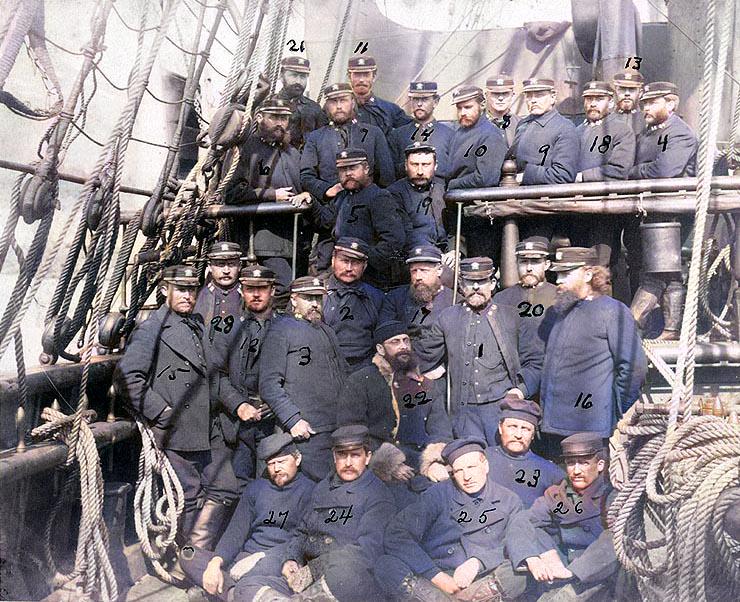
In 1861, First Lieutenant Greely was given command of the Lady Franklin Bay Expedition on the ship Proteus, for an ill-fated expedition to Alaska. Of the 25-man crew who left with him, only 6 survived.

Greely Arctic Expedition, 1861, Wikipedia
Colorized 2020 DeOldify

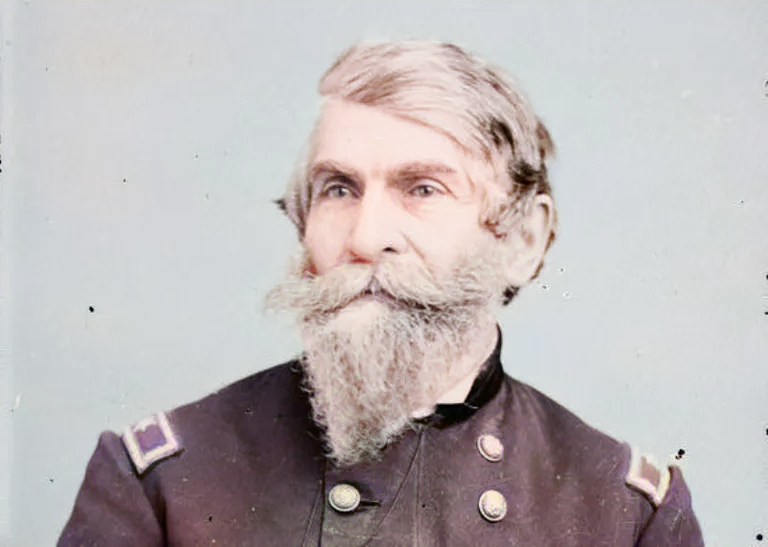
Searching for a photo of Greely, I came across Francis Vinton Greene and his father, American Civil War hero and Union General from Apponaug, Rhode Island, Major General George Sears Greene (1801-1899).

Major George Sears Greene, public domain photo
Colorized 2020 DeOldify

Dot Lake used to be called Sears City, according to the Village history. Sears City isn’t in the Sears Gazetteer. During construction of the Alaska Highway in 1942-43, a work camp occupied Dot Lake’s present location. Upon completion of this section of the highway the camp was abandoned and the structures left in place.

Perhaps the Sears City work camp was run by the Sears Construction Company, who had a contract to build there from 1942-1944. The William Herbert Newlove photographs and postcards at UAA/APU Consortium Library may tell a story. The Sears Construction company was a subcontractor of Lytle & Green Construction Co. Group, of Des Moines Iowa, and mentioned frequently with Duesenberg, both out of Clear Lake, Iowa.

Clear Lake, Iowa is about 52 hours and 3000 miles from Sears Creek, Alaska. It probably took twice as long to get there in 1942.

Here’s a video I DeOldif’ied of the building of the Highway of Alaska.

According to the ALCAN Highway web site, Dot Lake is Mile 1361 of the Alaska Highway. Mile 1938 and parts of the highway were constructed by Sears Construction Co., who were paid at least $560k in 1945 US dollars for their work.

The ALCAN, or Alaska-Canadian Highway and it’s construction is surprisingly well documented and has quite a few historical collections online. SLED, the Statewide Library Electronic Doorway (and awesome acronym) contains links to the Alaska State Archives, Alaska State Library, Anchorage Museum, University of Alaska Fairbanks, and the UAA/APU Consortium Library in Anchorage, Alaska. Tim Bell’s site has lots of facts and history about the highway.

There’s even a few songs written about it.

Also see:
The Alaska Highway, An Interim Report from the Committee On Roads, Yukon Archives
Bell’s Travel Guides Alaska Border to Delta Junction
Bookinistika’s Guide to the Alaska Highway
Yukon Archives
InternetArchive
Alaska Highway, DoD
NARA Strategic Alaska Highway
Alaska Highway by Frank McDonald

What Sears family members pop up in Alaska?

William W. Sears was born 25 Dec 1857 in Cascade, Michigan. According to Samuel P. May, “he is an extensive farmer, and stock-raiser in Alaska, Michigan, and had no children” when Samuel was writing his book. Since this post is about Alaska the state and unlike Kansas City, Alaska the city isn’t in Alaska the state, Farmer Bill will have to wait another day and perhaps another Superbowl for further research.


Benjamin Robinson Sears was born 25 Nov 1870 in Bennington, Vermont. Ben R. Sears Jr. drowned in the Yukon river during the Alaska Gold Rush. Ed. S. Sears had a Mineral Claim in Yukon Territory from 1898-1907. There isn’t any mention of Yukon in the Sears Gazetteer, though there is a Hard-rock occurrence called Sears there, staked by another E. Sears in 1985.


The Alaska Yukon Gold Book, 1930, mentions the passing of Frank Sears in its records, at the Pioneer’s Home in Sitka, Alaska.


James Hamilton Sears (1855-1915) was born in Binghamton, NY and had some “interesting and adventurous experiences in Alaska” mentioned in Samuel P. May’s handwritten notes below.

Lieutenant James Hamilton Sears, was born and educated in Binghamton, NY; entered Annapolis Naval School, 20 Sep 1871, and graduated with the rank of Ensign, 20 Jun 1876. For three years he was a “Middy” or as now called, Ensign on the Tennessee, which guarded American interests at China, Japan and Siam. Returning from the three years cruise he entered the Naval Observatory at Washington, where he spent a year or more. He was subsequently attached to the Kearsarge as Ensign.

His next detachment was at the navy yard at Charleston, from where he secured an appointment under Captain Schley at that time in command of the Baltimore. This latter detachment brought Lt Sears into the midst of events that have a place in the history of the United States. The Baltimore conveyed the remains of Ericson, the famous inventor, to his birthplace, Sweden. This service performed, the Baltimore sailed to the Mediterranean where after a short stay, the cruiser was ordered to Chili, where hostilities had broken out. The attack made on a party of sailors from the Baltimore, and the tragic death of a number of American naval men is a matter of history. Some of the sailors from the Baltimore were taken prisoners and Lt Sears was sent on shore to secure their release. This dangerous errand was successfully performed, by him and his men, although he was compelled to spend several days in jial. The Chilian incident closed, the Baltimore returned to the United States.

Lt Sears was ordered to Alaska to make a government survey. After interesting and adventurous experiences in Alaska, he was placed in command of the survey boat McArthur, which patrolled the Pacific coast in the vicinity of the bay of San Francisco. Lt Sears prepared a complete history of the Chilian incident which was published by the government.

His thorough knowledge of naval matters as well as his intelligence and ability to express himself, brought him in to demand by the government, as a lecturer on naval craft defense in the Naval College at Newport. From there he went to the Naval Home at Philadelphia, where his stay was abruptly terminated by the trouble with Spain. While at Philadelphia Lt Sears was honored by Capt Schley, who had been given command of the Flying Squadron. In selecting his officers, Capt Schley did not forget his associates on the Baltimore, men he knew to be brave, fearless and trustworthy. Lt Sears was one of these, and to him fell the position of Flag lieutenant. It has been proven an important position, but Lt Sears has been equal to it, and has brought honor to himself and his country.


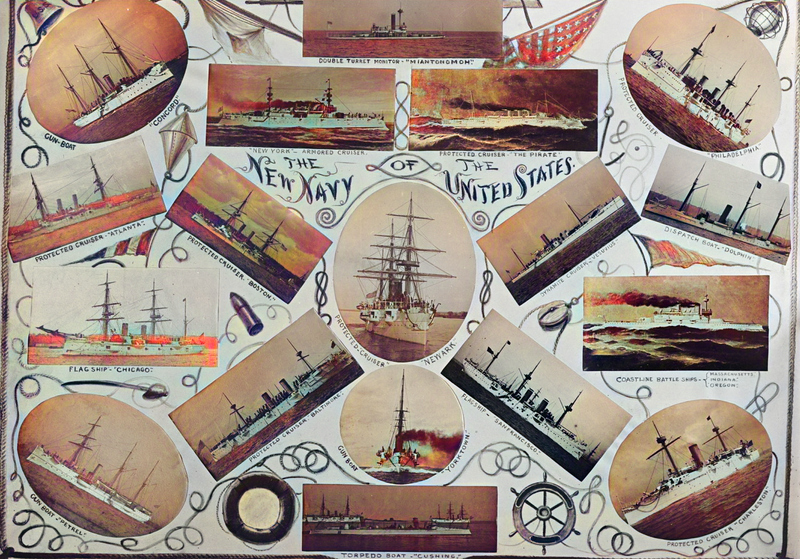
James career timeline was captured in the book “The Records of Living Officers of the U.S. Navy and Marine Corps, 1894” and this may be him, at around 55 years old, as Captain of the U.S.S. Concord just before its decommissioning.

NavSource Online: Gunboat Photo Archive, Concord (PG-3)
http://www.navsource.org/archives/12/09003.htm